We can hardly believe we have been in Oaxaca for over 4 months. After one week of orienting ourselves to the city and finding our apartment, we started Spanish classes at Instituto Cultural de Oaxaca (ICO). The school is located on the grounds of a former Hacienda and the owner, ladueña, is a quirky character who runs the place with what some would describe as an iron fist. For example when we first visited ICO and asked to sit in on a class, she told us absolutely not… there was no way. A few minutes later without explanation, we were shown into classes to observe the learning environment. This is just one example of the countless situations that come to pass, in which we don’t quite know what is happening. But it was the start of our relationship with ICO, its fabulous teachers, and our lovely compañeros (classmates) from around the world.
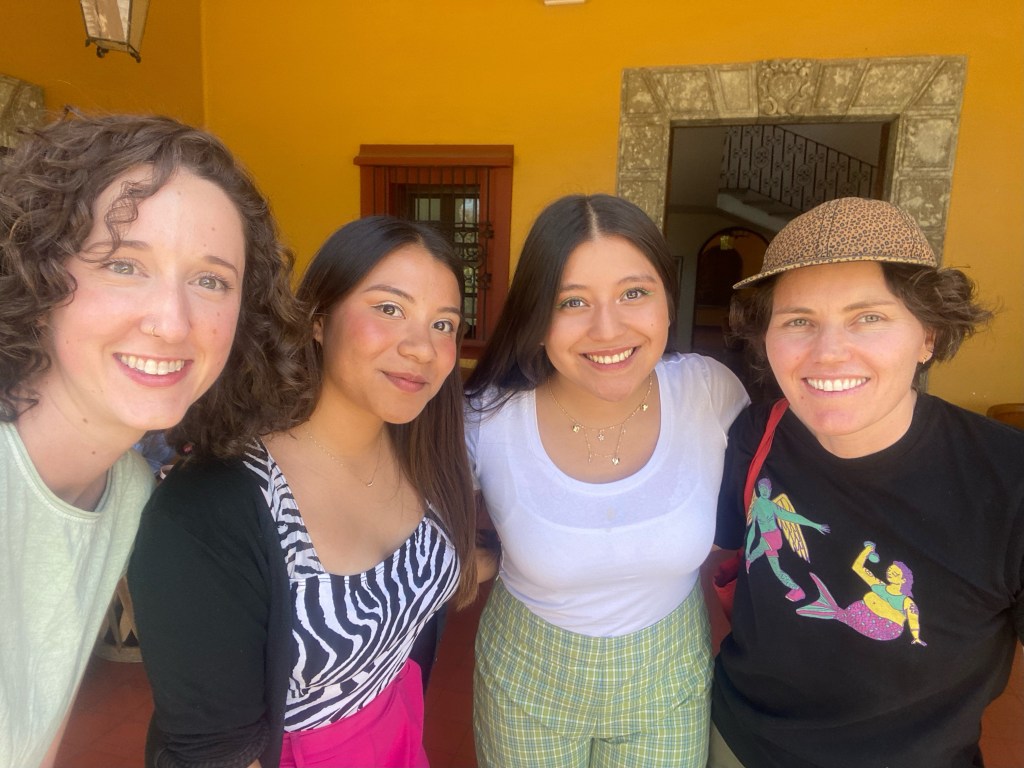
Our first teachers at ICO, Valeria and Rachel, who are now our friends 🙂
Over our 9 weeks at the school, we came to love and appreciate the savvy of the school’s staff in teaching under the watchful eye of la dueña. We each had 3 teachers; our last instructor, Andrea, we shared for 5 weeks. At times we feel our Spanish skills growing exponentially and at times we feel incredibly discouraged. Learning a language humbles us and we find ourselves looking to the example of children who put themselves in positions of learning every day.
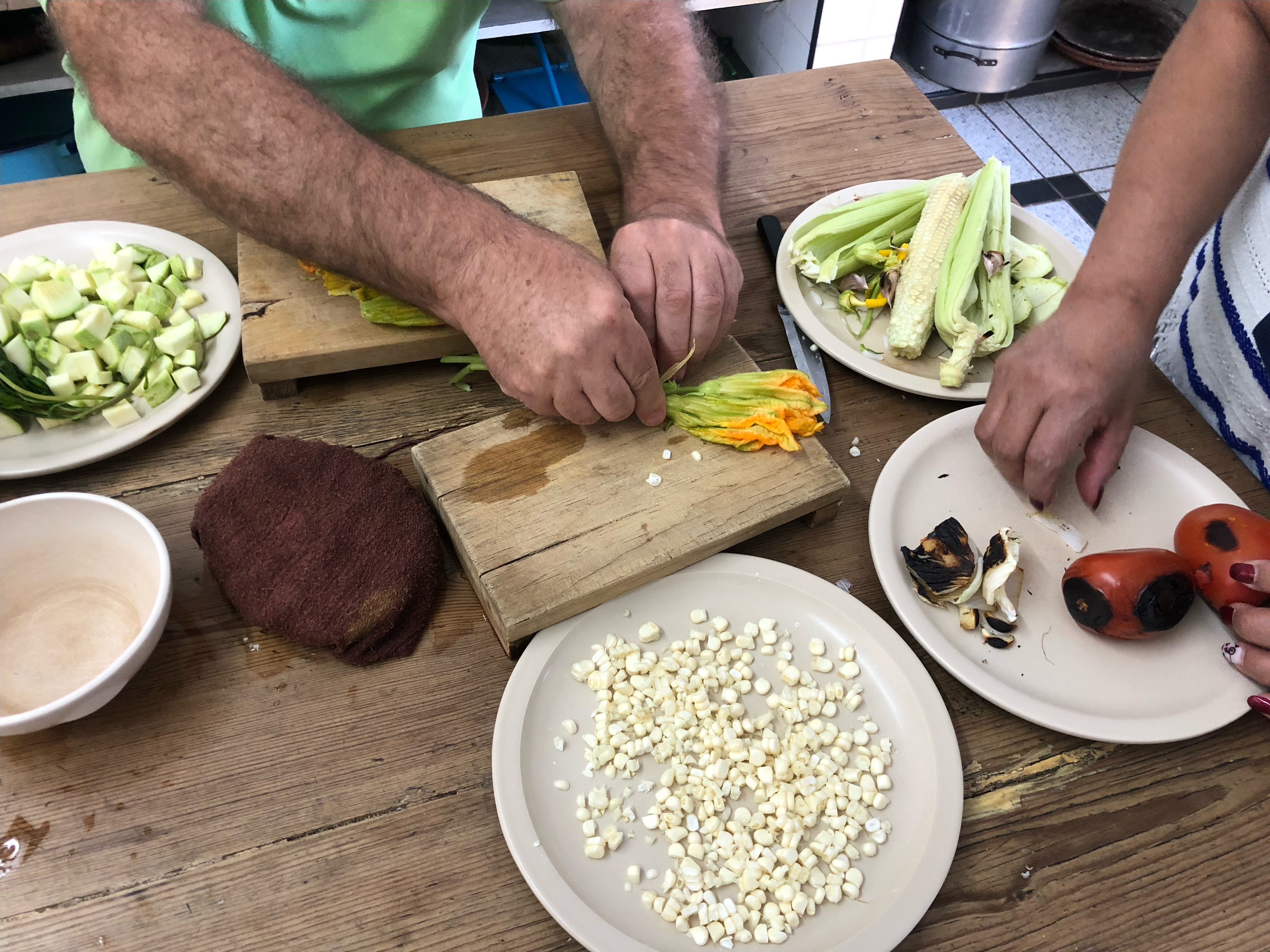
Shey’s classmate Frank from Belgium and instructor Mayela cook a sopa (soup)
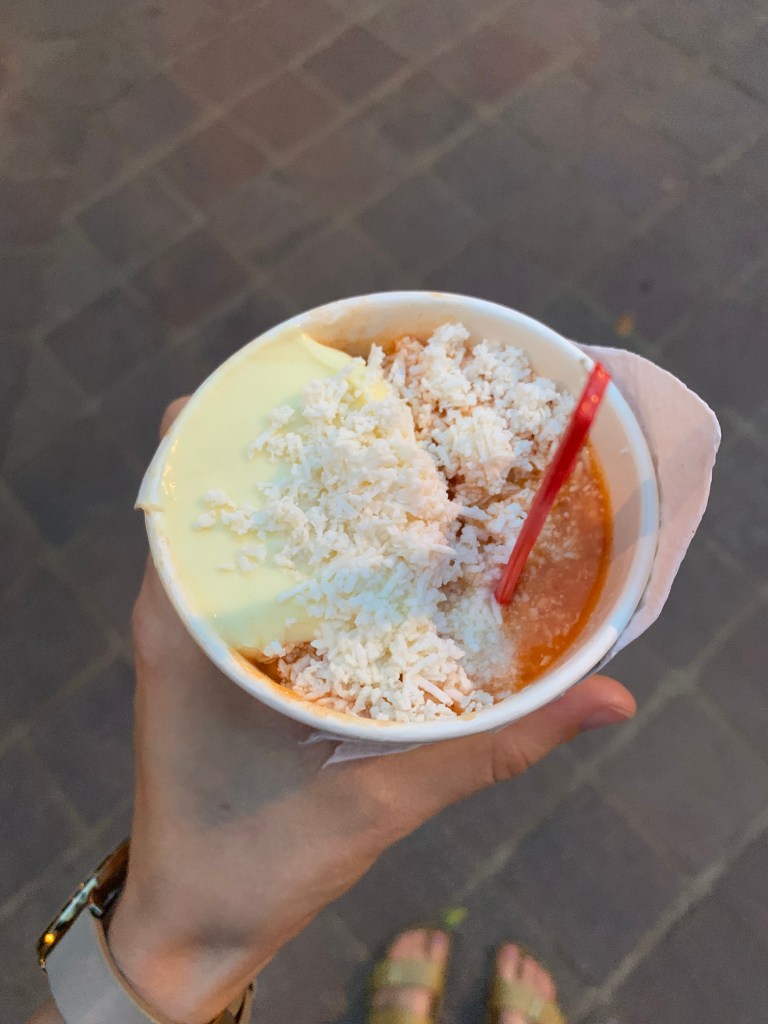
Another perk of our school were the elective classes. Shey took cooking, photography, and salsa, and Anicka joined for a second week of salsa. The class brought us from the most basic, básico, steps all the way up to more complicated vueltos, turns. Our instructor, Roberto, can only be described as a suave gentleman; he is both gentle and firm, and makes you feel like you are a skilled dancer with him as the lead. In addition to dancing, he also took time to teach us about Spanish terms, the state of Oaxaca, and Mexican culture. After our week of lessons, we started attending weekly salsa sessions in a plaza and have become regulars. Our Tuesday night routine has become: light dinner, salsa dancing, and then street tacos and esquites or boiled, spiced corn with mayonnaise, queso, and limon in the park on the way home. Although ICO offers many great aspects, we decided to transition from this formal learning environment to private conversation practice, so we can solidify what we’ve already learned and have more time to speak.
Esquites from our favorite spot in El Llano Park
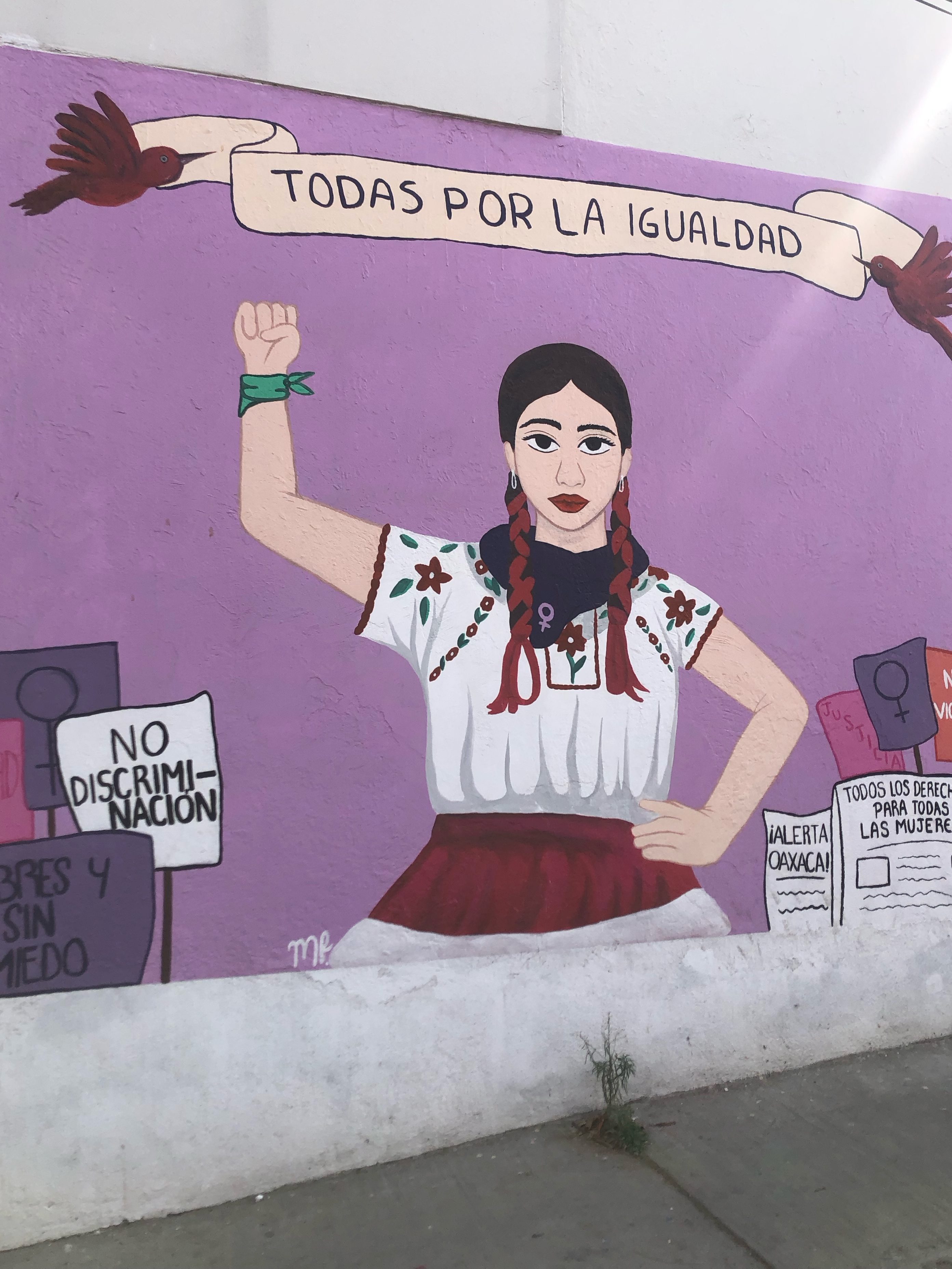
Outside of school, one element of life and Oaxaca that we have come to know is la lucha, the political struggle via demonstrations by various groups. On International Women’s Day, March 8, we watched a march to draw attention to violence towards women in Oaxaca, and in the country overall. This group walked through the streets of Oaxaca toward the main square. Most were peaceful and put up signs with reminders of missing or murdered women, and a few tagged buildings and broke windows. There have also been several instances of groups taking over buses and parking them to block traffic in major arteries. We have been impressed at the scale and organization of these groups. Two weeks ago we walked through the main square, or Zócalo, and came across hundreds of teachers who were camped out there advocating for higher wages. This area routinely hosts events and is typically teeming with musicians, tourists from Mexico and abroad, local families spending the evening, and vendors selling various wares and tasty food.
“All for equality”
The state of Oaxaca is one of the poorest in Mexico, despite booming tourism to Oaxaca de Juarez (the largest city, where we live). The example of activism has been set by indigenous groups in the mountains, many of whom continue to reject Mexican policies and practices in their home communities, deciding instead that they will handle conflict and governance themselves. Some of these groups maintain that they have not been conquered; they continue to speak their native dialects rather than Spanish, and live according to their people’s customs.
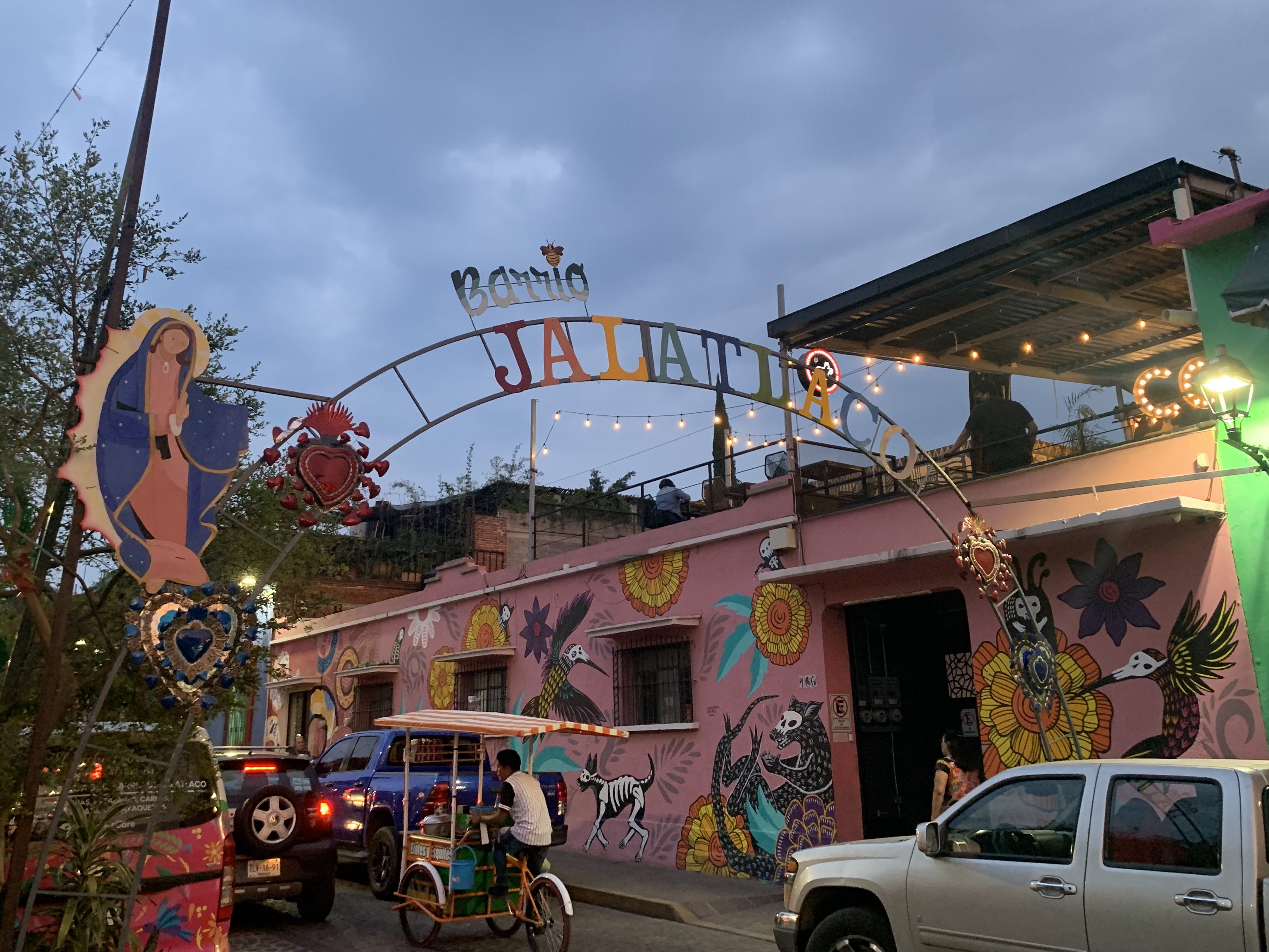
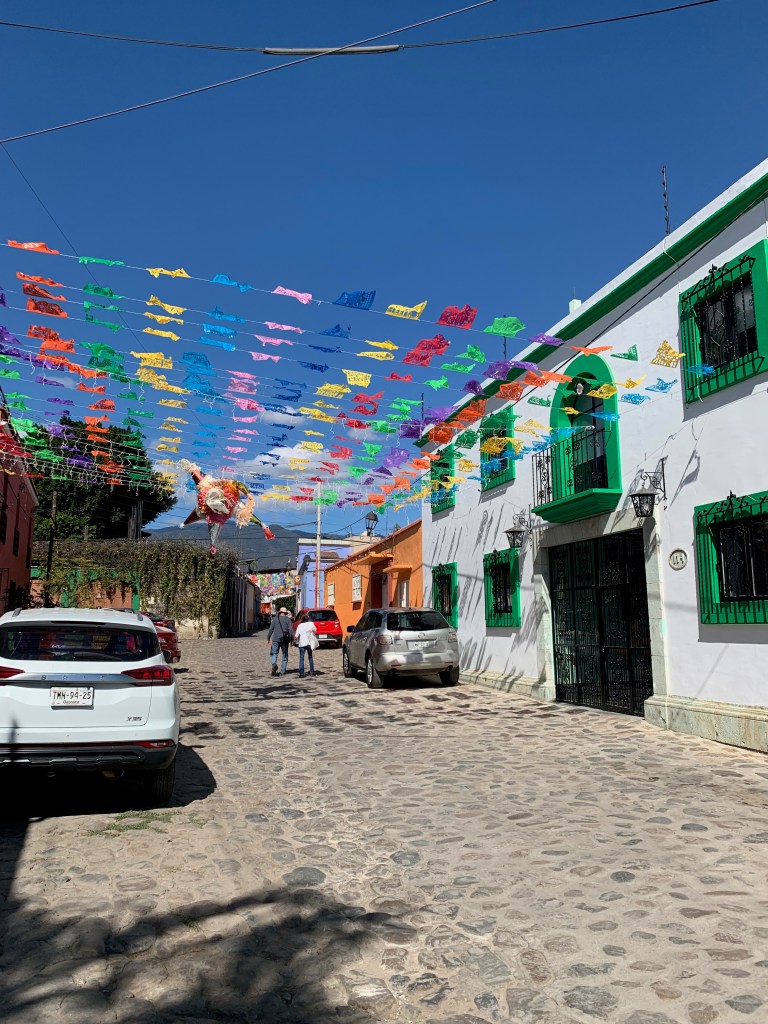
The entrance to our neighborhood, Jalatlaco
By this point we are finally starting to have a few steady friends, we have a system for buying our fruits and vegetables and then cleaning those fruits and vegetables, our neighbors wave to us or talk to us on the street, we attended our first birthday party, and we welcomed our first visitor, Virginia, at the end of May. We are learning an incredible amount about ourselves and about our relationship, and about how we want to move forward with our lives. Some days we are overwhelmed with this challenge, feeling at times like we’ve put ourselves back in a Covid-times bubble where the only people we can see or speak with are each other. But one day at a time, or paso a paso as they say here, we are settling into our life and finding some joy every day.
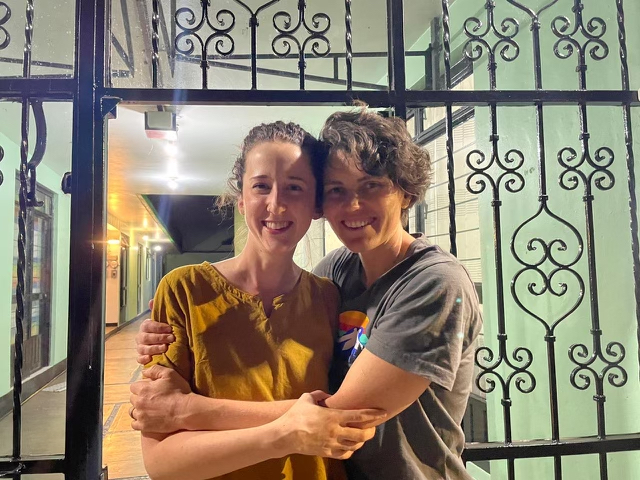
Outside the entrance to our apartment, after hosting friends for the first time!
We made it! There have been so many fun moments, lots of gratitude for the ability to be here, a few tears, plenty of delicious food, and steady progress with our Spanish.
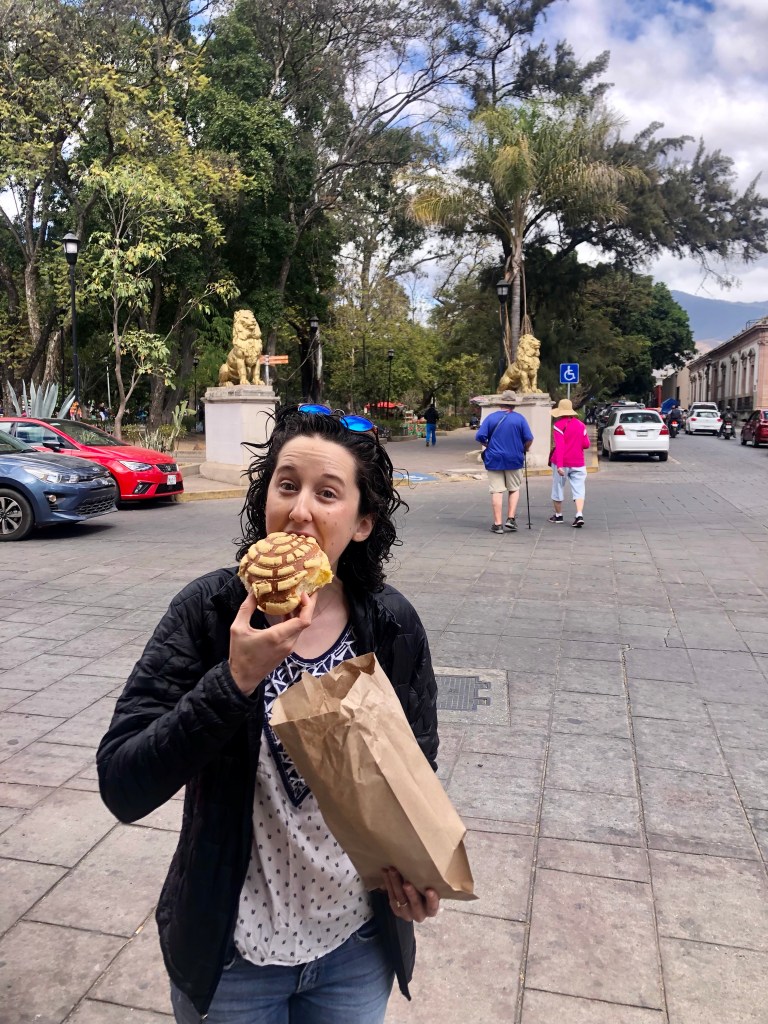
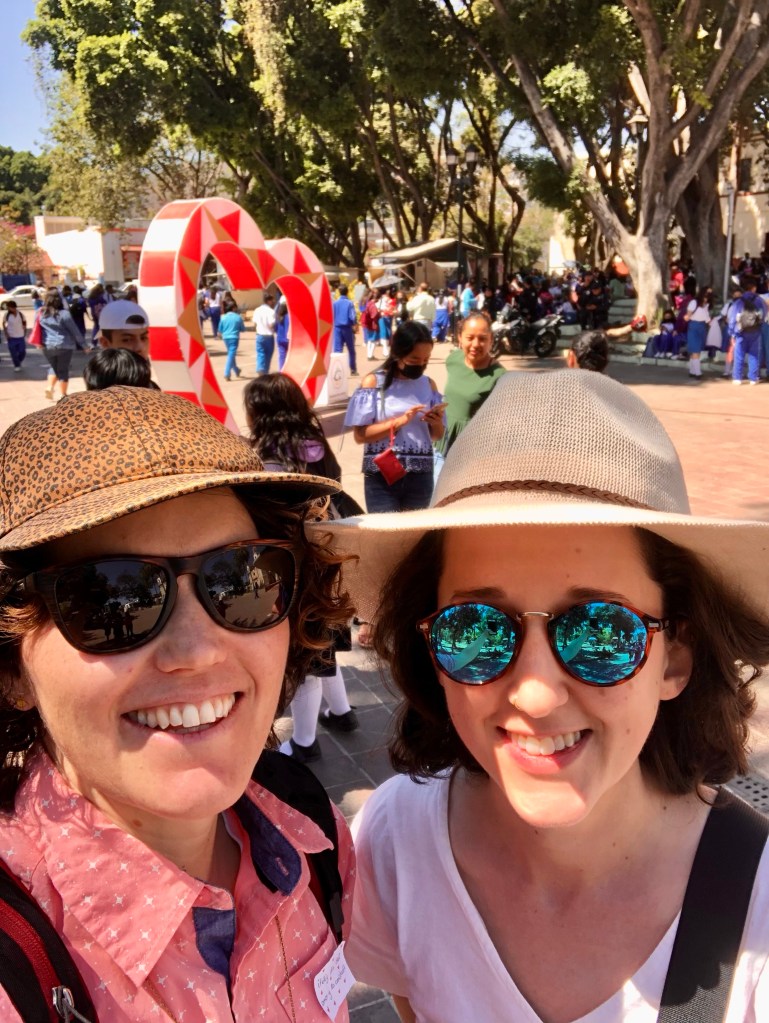
One of our first days in Oaxaca, eating fresh baked concha in front of our favorite park, El Llano.Valentine’s day on our way home from school, also in Parque El Llano! Every day we walk through throngs of secondary school kids who are dismissed the same time we are.
Our first week we jumped immediately into searching for a long-term place to live. The apartment hunting process was challenging to do from the US. Seeing places in person, as well as getting to know the city helped tremendously in figuring out where we wanted to be. We found our apartment after visiting a different apartment we weren’t excited about due to location, and meandering back to our Airbnb past a “se renta (for rent)” sign with a phone number. We texted the number and got an immediate response that that apartment was not available but we could see another the next day. It happened to be in a neighborhood we loved walking through, near a park where we frequently sat to watch all the activity, and only 15 minutes from our language school. It seemed too good to be true! We toured an apartment that is the landlady Señora Teresa’s auxiliary apartment, complete with her wedding photo, lace tablecloth, delicate glassware, ceramic wolves and angels, and pictures of Jesus and Mary on the walls. It was a temporary stay before our apartment was vacated. After discussing the terms of the lease entirely in Spanish with the significant assistance of Google translate, we signed a four month lease and made plans to move in the following week.
Our apartment is through the black gate on the left.
We gave ourselves a week to rest, learn, and recover from months of planning, stress, and moving. In Anicka’s case, it was also the perfect time to get sick, be miserable for a few days, take antibiotics, and bounce back ready to move in to our new apartment, start Spanish classes, and start doing telehealth private practice. Our language school is called the Instituto Cultural de Oaxaca, and it came highly recommended by several friends. Anicka tested into A2.1, a level above basic, and Shey tested into A2.2, the next level up. We quickly learned the routine of 1.5 hours of Spanish learning and practice in the classroom, a 10 minute break, another 1.5 hours of Spanish learning and practice, another 10 minute break, then an hour of conversation in the courtyard/garden surrounding the school. Every transition is communicated by a hand-rung bell. We loved our teachers, both freshly graduated and very engaging. They were excellent and made us enjoy going every day, despite feeling saturated like wet sponges by the end. We also came to know many of our classmates well and connected closely with several of them. (Hi Katherine and Davis!) It was refreshing to have more structure to our lives and people to see and talk to, other than each other. Who knew being together 24/7 in an unfamiliar environment would have its challenges… but also its joys!
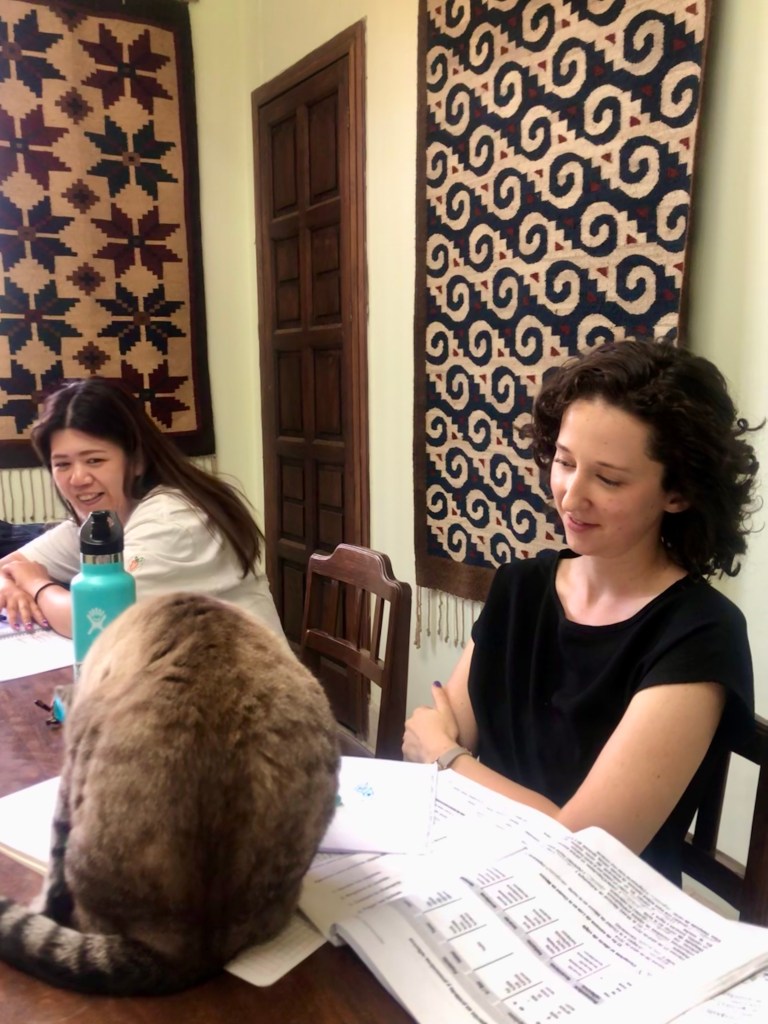
Outside our school! Instituto Cultural de Oaxaca.In class with our friend Mizuky and Guicha the cat (not a friend).
There has been a lot to learn outside of the basic ability to speak: how to turn on the water heater to be able to take a hot shower, how do we clean this tomato so it’s safe to eat, which car has the right of way in the street, how to wash our clothes, where to get filtered water, why a man frequently walks through our neighborhood pushing what looks like a smoking chimney and blowing what sounds like a train whistle (we still haven’t figured that one out). Every day is something new, which is both exciting and exhausting.
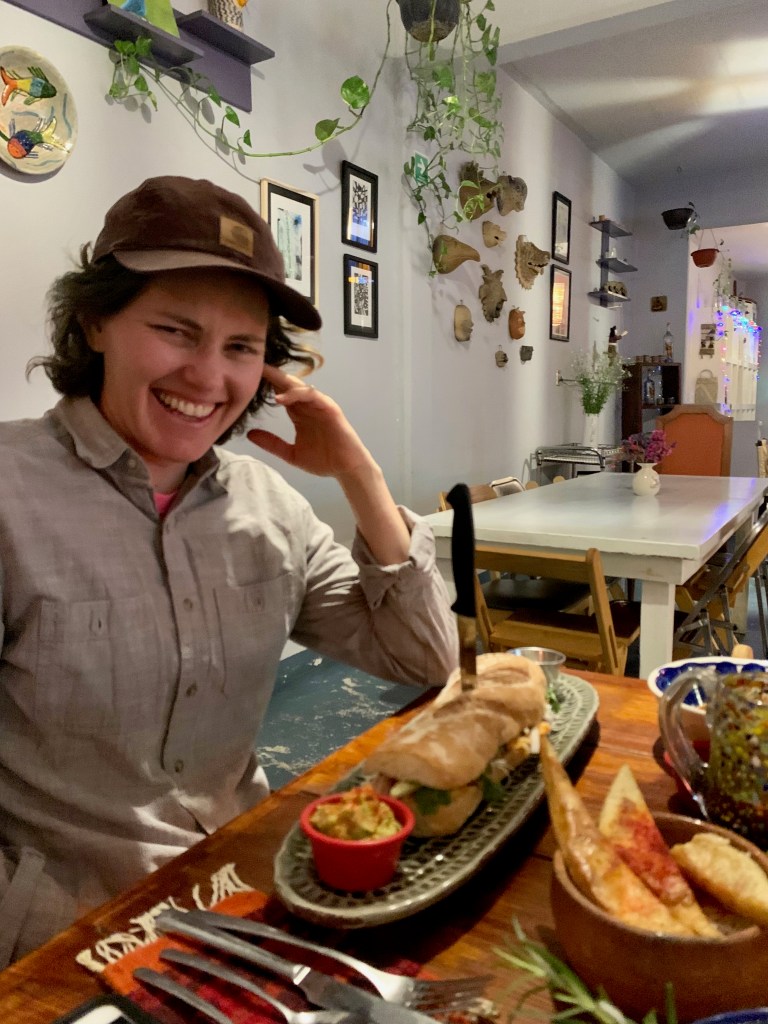
We celebrated our 4-year anniversary of dating at a super delicious restaurant less than a block from our apartment.
We have plans to travel to the Pacific coast and explore costal towns, with possibly some mountain town stops along the way. We have tickets to a concert, Jessie y Joy, on April 1st. We’re inviting everyone we know, which includes you if you’re reading this blog!, to come visit us!
By now we have been in Mexico for over 4 weeks and had a stop over in Guatemala City BUT we can’t leave our last days in Belize untold! They were some of the most spectacular.
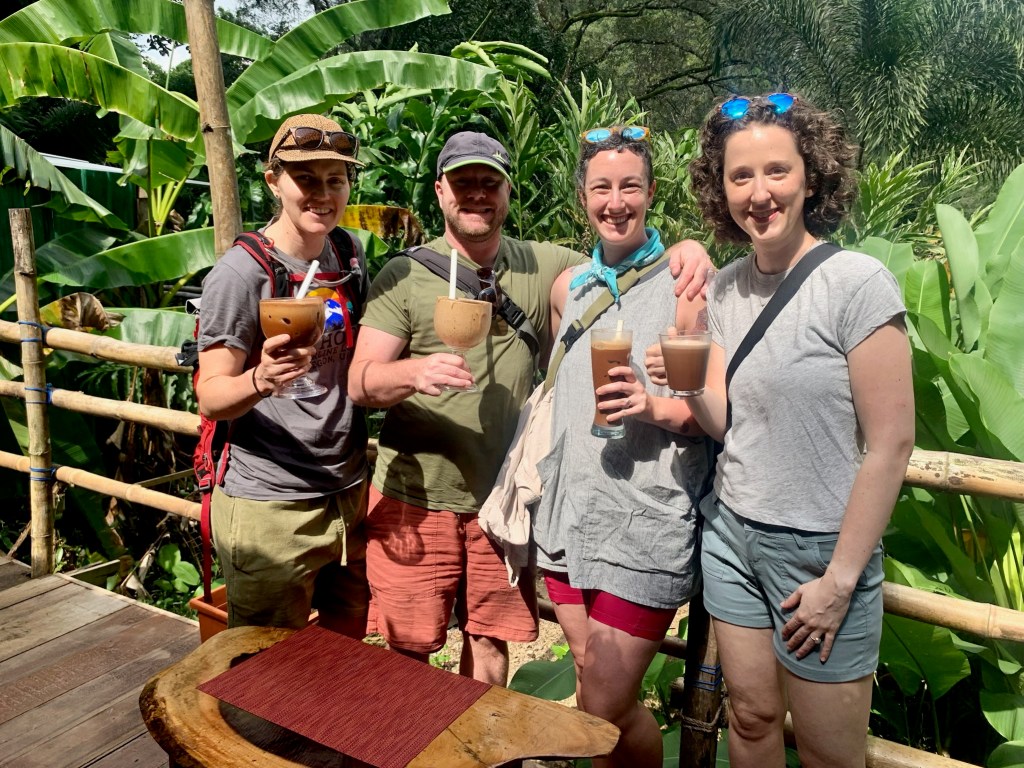
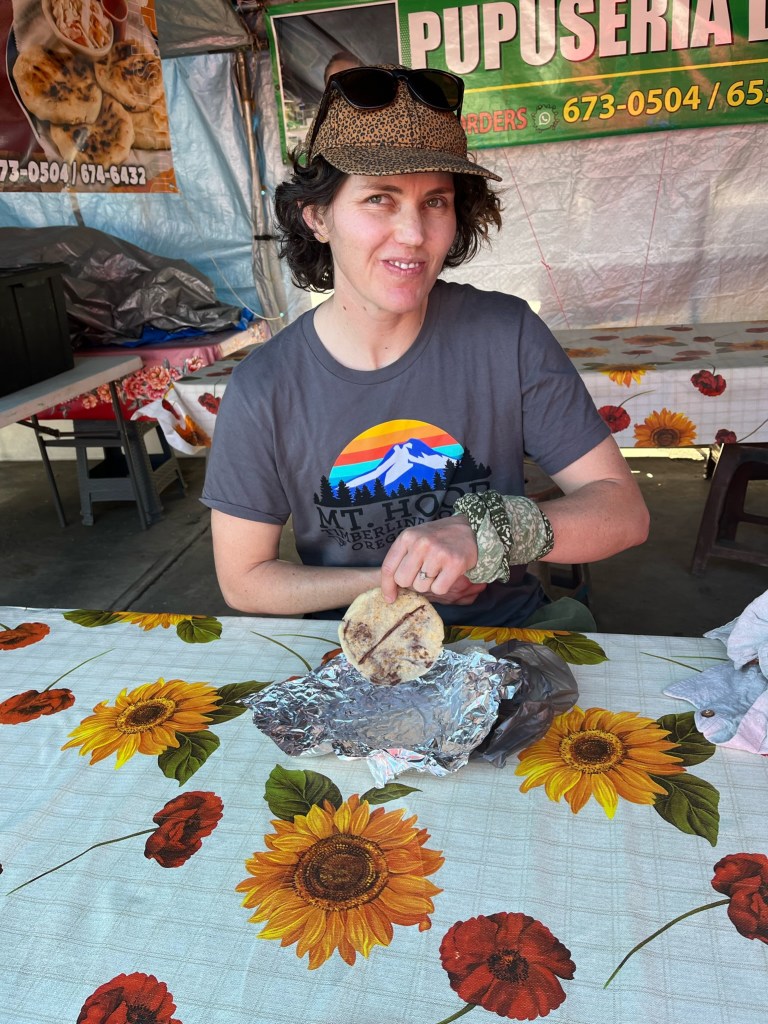
We loaded up our now-trusted Ford SUV and drove from coastal Hopkins to jungled San Ignacio, a town that is about 15 miles from the border with Guatemala. Along the way we stopped at a chocolate and coffee jungle bar where a few of us got a little too buzzed on a combination of the two. We were able to sample many different forms and flavors of chocolate, including clitoris (umm, the flower) and we learned how it is made. We explored incredible tropical walking paths on the grounds while we sipped our caffeinated concoctions. We took our time on the drive and then explored the town of San Ignacio that evening, including the market. This part of Belize feels much different; the Hispanic and Indigenous influence is very present in the language, food, people, and wares. Zoe was the bravest Spanish speaker in the group and led the way in getting pupusas.
Shey shows off a vegetarian pupusa, marked as such with a line.
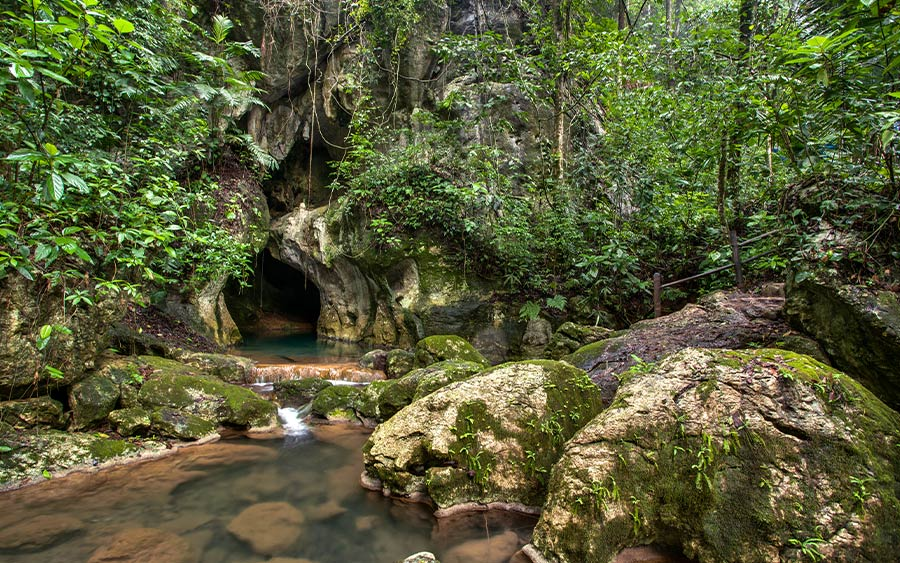
Early the next morning we headed to the meeting point for a guided hike into the Actun Tunichil Muknal (ATM) caves. Some playful locals told us that the real name for the caves was “Another Tourist Missing,” but also warned frankly that flash flooding can be a real risk in the caves. If the creek that runs through the cave rises too quickly due to runoff, it can make navigating out of the cave impossible. Tourists are not infrequently trapped inside until water levels recede to allow for safe passage.
Our guide, Basílico, was from the Maya village of Red Bank, where we saw the Scarlet Macaws (see last entry). He provided us with helmets and headlamps and made sure we all had appropriate footwear for creek walking and spelunking. We started up the trail after Basílico confirmed, “Can you all swim?” Waivers and releases of liability aren’t really a thing in Belize. A quarter mile into the walk on the way to the caves, Basílico stopped at a tree and pointed out scat of a small carnivore. “We both like this tree,” he said, smiling, and fished out some obsidian blades from a little cavity within the trunk. Millennia ago, the people who lived here used the stones to make sharp blades for tools. He told us that blood letting by ancient Maya priests was a means of appeasing unhappy Gods. Basílico hit the tree’s truck a few times with a rock’s edge and pulled elastic strands from the apparent rubber tree. The material was used to make the 9 pound balls played in the ball courts of Maya cities.
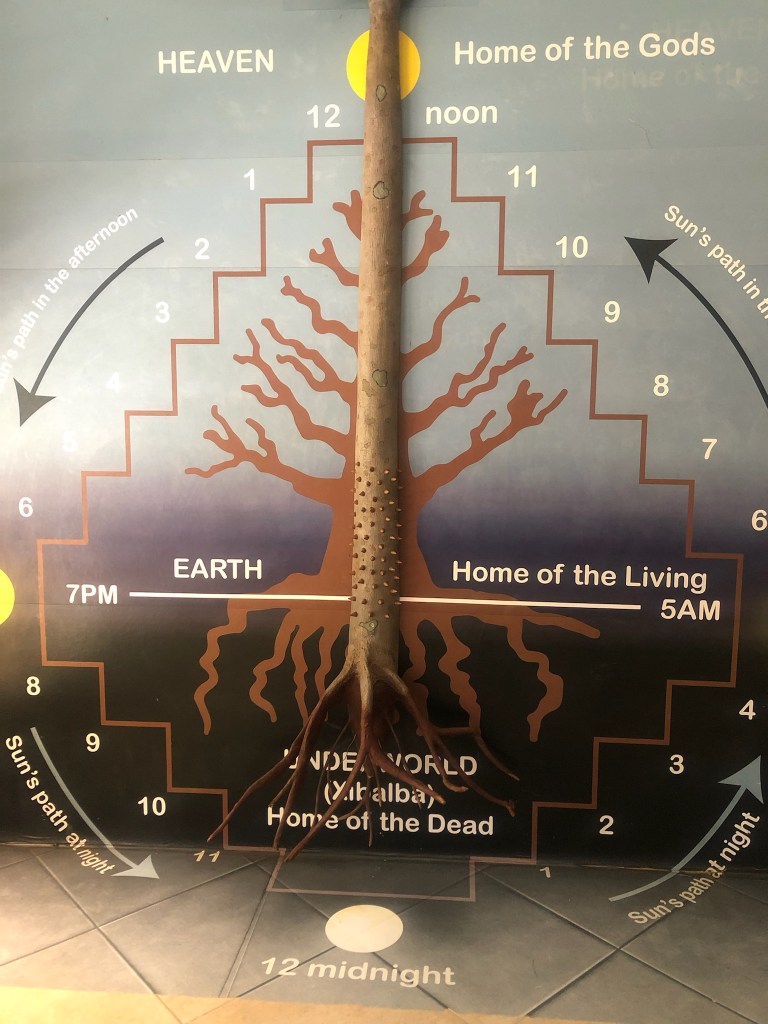
Only about 20 guides are certified to take people into the caves, given the knowledge needed to safely navigate the caves and expertise specific to their history and importance to Maya groups from between 300-900 CE. The cave provided a connection between earth and the underworld, the land of the dead, Xibalba.
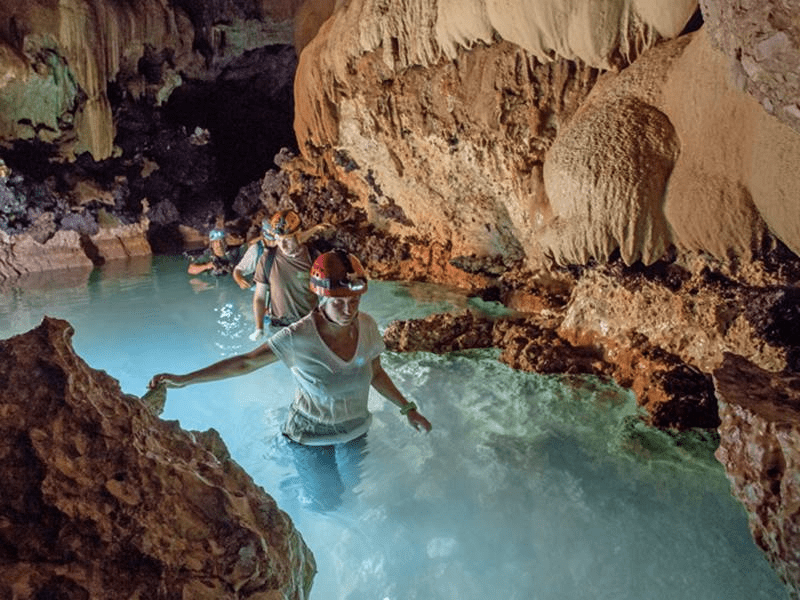
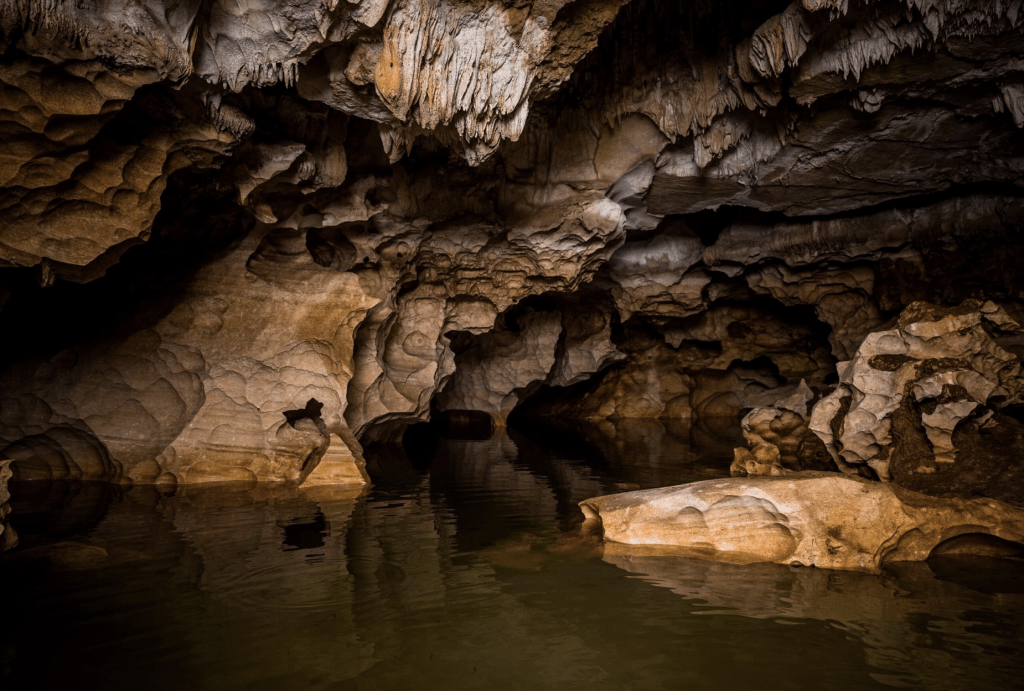
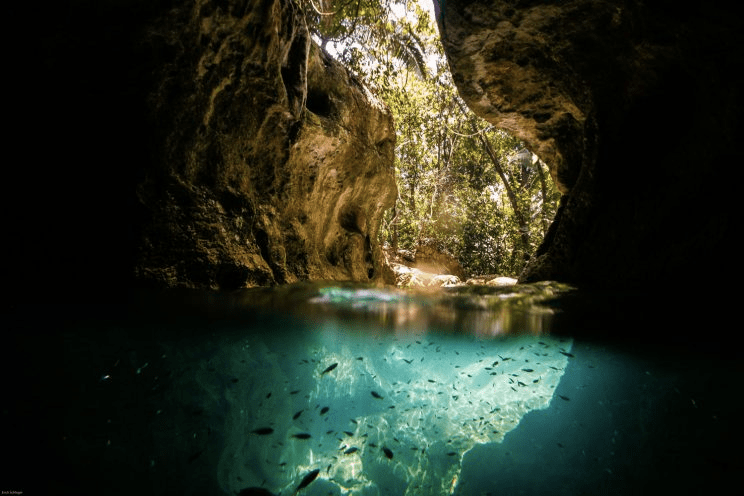
We braved three river crossings using ropes to guide us and arrived at the entrance to the caves. Entering the cave meant turning on our headlamps, walking down to a creek flowing out of a cave, and jumping into a pool of cool water. Then we swam into the darkness. “Don’t put your heads under! You will ruin the headlamps!” we were told. With the warning about flash floods fresh in our minds, we dipped in and out of creek pools inside the caves, marveling at the natural formations inside. We scrambled over rocks and through narrow passageways for about 400 meters, before climbing up a particularly large rock into a large, open cavern.
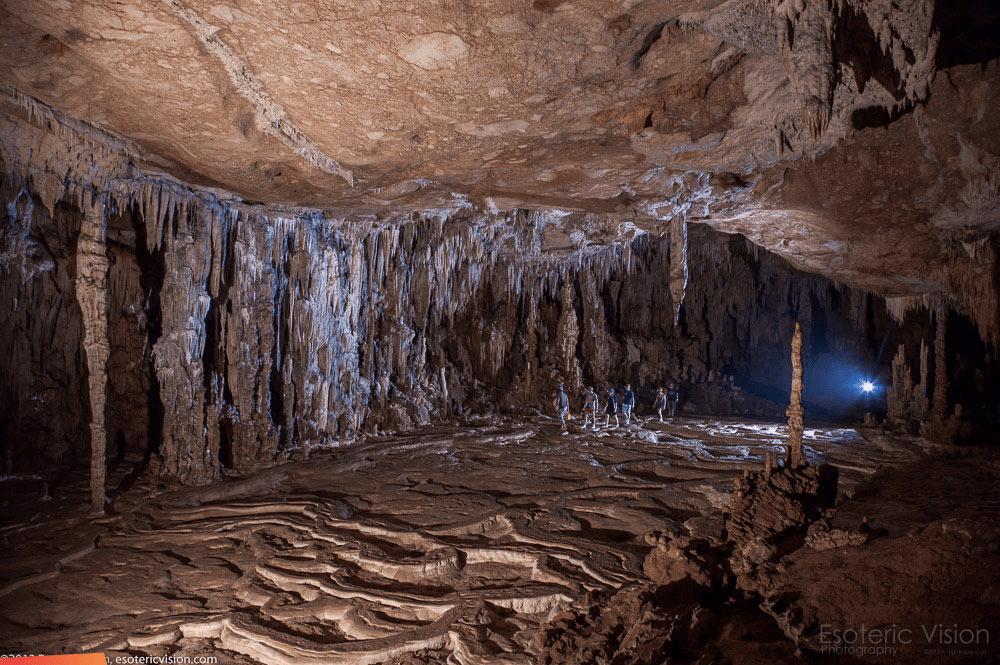
We were asked to take off our shoes and wear only socks or bare feet into the chamber. At first, we saw only pottery– many broken, some intact; these earthen ceramics were impressively thin considering the pots were made with coil techniques. As we entered further, we began to see skeletons and signs of the human remains of people who were sacrificed. Many were young, some were bound or had broken bones. Cameras and phone use is banned due to a number of incidents of tourists dropping them and destroying the fragile remains. Basilio pointed out one of skulls that was broken from such an incident and then he stole away around the corner and returned with 2 front teeth that were knocked out. Each front tooth had three uniform grooves sanded into it, a common cosmetic practice in the time.
We went further and further into the chamber, passing groups who were on the way out. There were many more human and material sacrifices among the crystalline stalagmites and stalactites. We scaled a rickety aluminum ladder, slippery from so many damp and sandy tourists’ feet, and finally came to the most famous artifact in the cave: the Crystal Maiden. Resting at the farthest reach of the chamber, the skeleton sparkles because of the calcium in the dust that has settled atop the bones. Originally believed to be a woman, archeologists later discovered her to actually be a teen boy. The chamber became quiet as the proceeding groups descended back toward daylight. We all shared a moment to marvel before also turning back. Within a few minutes of beginning the return, one of our fellow tourists’ headlights went out. Bacilico urged us on, “We need to hurry and get out before we lose more batteries!” Down, back into the creek our group scurried after putting our shoes back on at the chamber opening. We did our best to tread swiftly over the gravel and navigate the hidden rocks looming in the water–waiting for us to crack our shins upon. One by one, headlamp after headlamp died. By the time we saw the light of day, we were down to only three lights among the nine of us and were thus traveling very closely to one another. The trip was spectacular, if slightly terrifying, and incredibly humbling to witness.
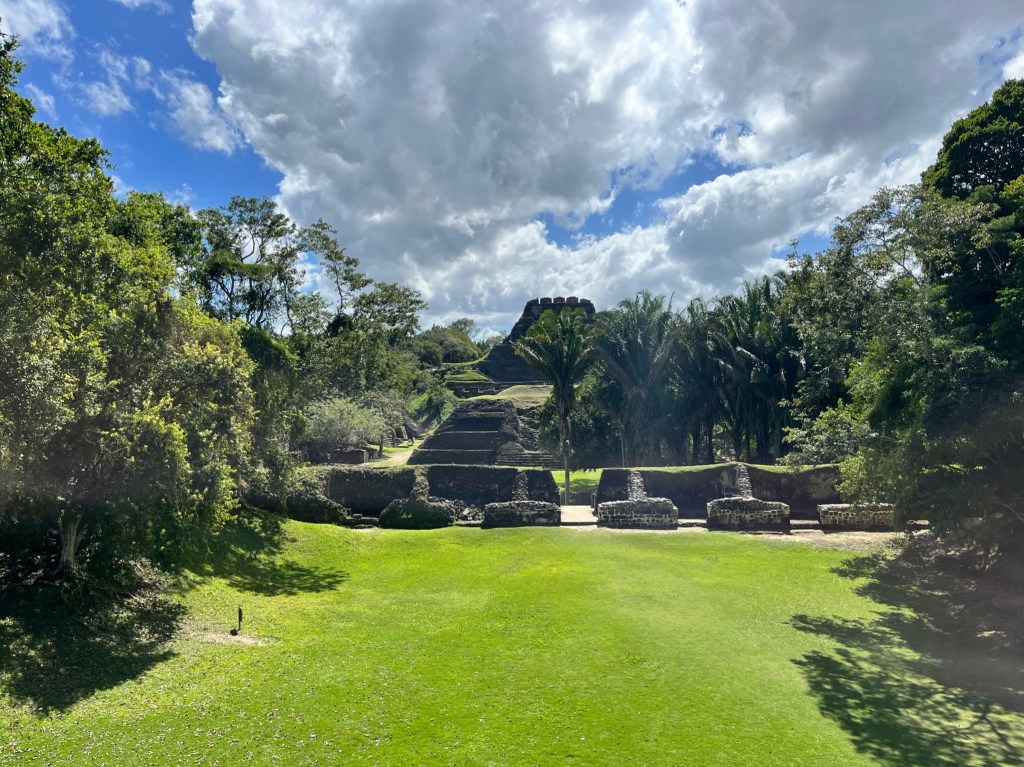
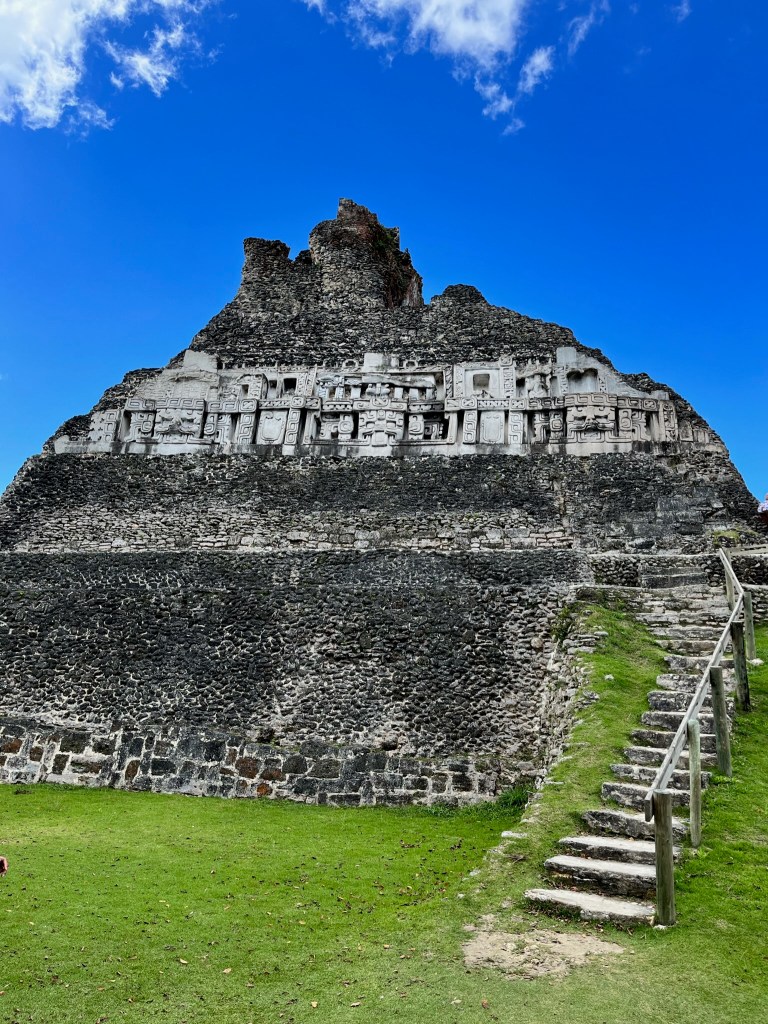
The next day we visited the Maya ruins of Xunantunich on the border with Guatemala. Guides wait in a shady shelter near a hand-cranked ferry. You hire them there, then they get in your car to cross the ferry and drive the mile up to the park. At the entrance, we met a very sweet spider monkey who comes by daily for a treat from the staff there. His big eyes and tiny face filled us with tender awe, and reminded us of another tiny-faced, big-eyed mammal we miss very much.
Our guide told us tales of the Maya people and brought the ruins to life. A lot of the information he shared pertained to the royalty who lived atop the mountainous palace. Common people would come to the area for market, but lived in the surrounding land. As we climbed the structures, the rolling hills surrounding came into view. At the height of its power, all the surrounding land was cleared and cultivated with corn and other crops. Today it is covered in jungle. It is believed drought associated with deforestation came to the area and may have caused the civilization to collapse, though the exact cause is still unknown.
A recreated facade hints at the past splendor of this Castillo (castle): now only home to bats and iguanas.
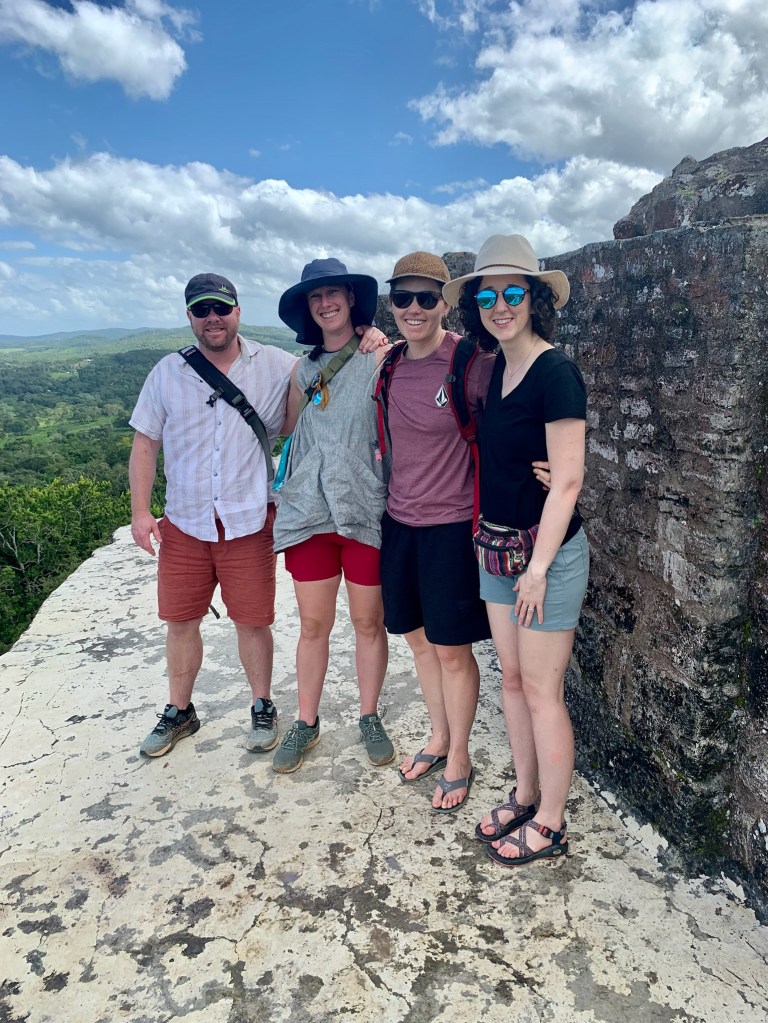
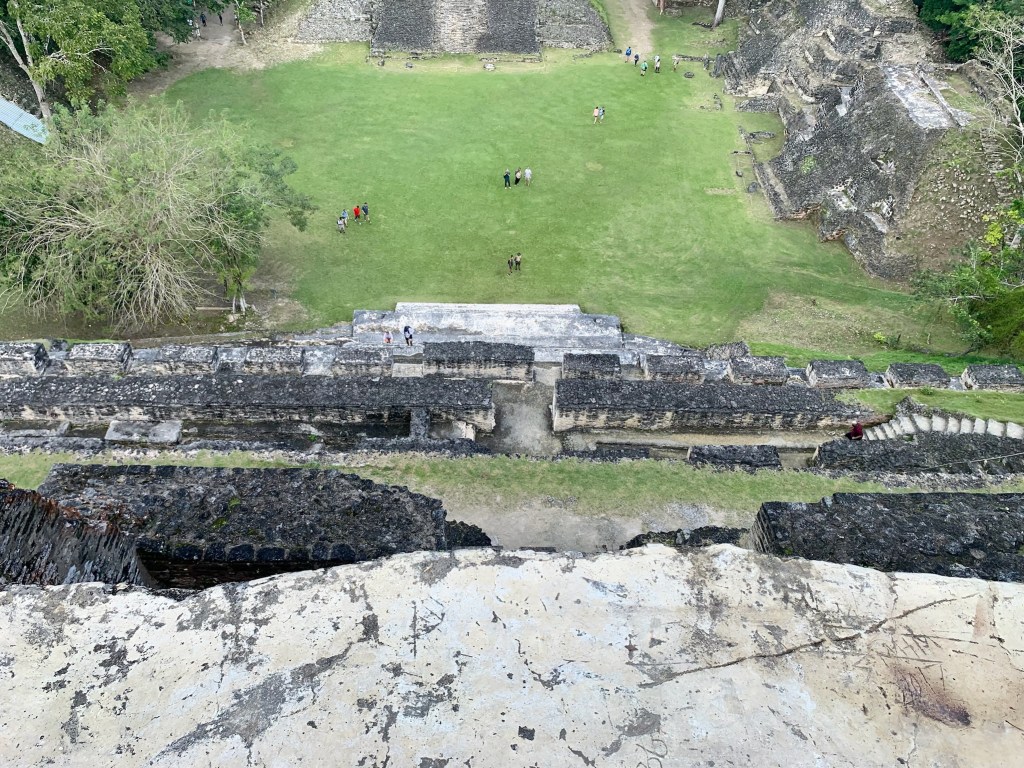
After a hot and steep climb, we rested atop the highest of the ruins. This structure housed the ruler and staff. It brought home the feudal nature of this time. As we looked out, Anicka spotted a toucan flying in the treetops below us. We all erupted with excitement as we watched it glide around the courtyard and then drop into a tree’s branches. We listened to the echoing sounds of a howler monkey in the distance and spotted large iguanas lounging among the tree branches. Animals provide so much more delight than the thought of dynasty and lords.
View from the top, looking down into the royal courtyard, where only nobility was permitted to tread.
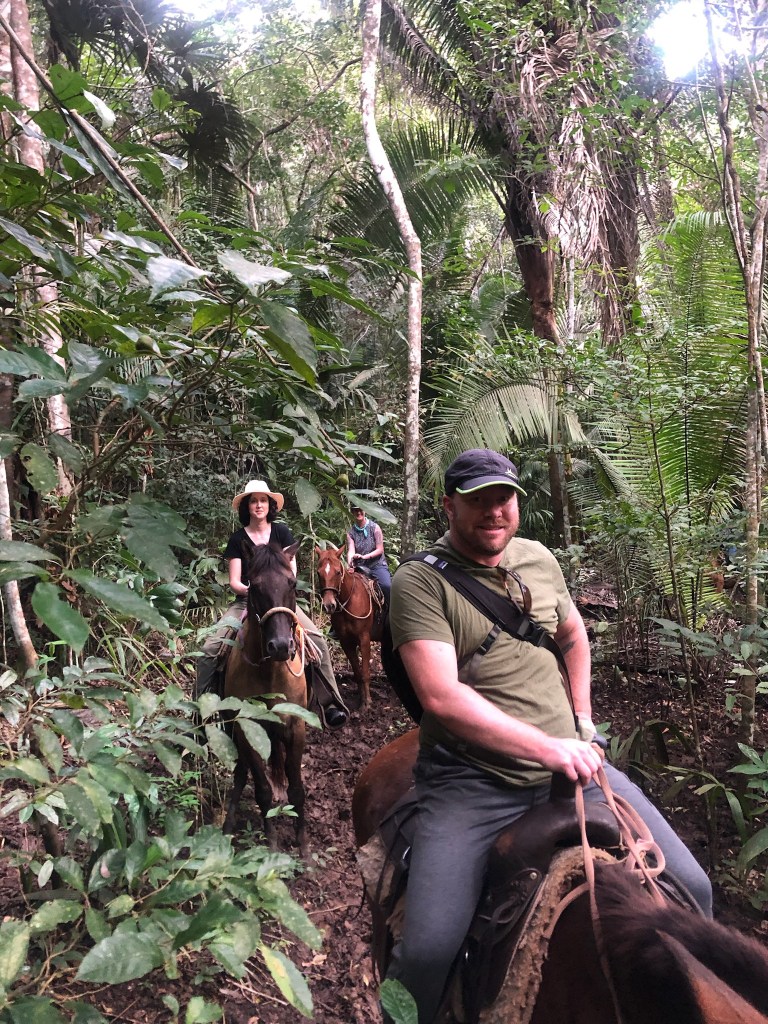
Our final and most adventurous activity came after we left the ruins and drove up a very rocky, very long jungle road. We cranked some country music to drown out the groans of our struts on the way to Martz Farm. When we reached our destination (according to google maps), all we saw was dense jungle, but after a few hundred feet more of driving, there was a driveway. After a few miles of driving in the dense forest, the road led into a beautiful meadow with a tranquil farmhouse by a river and a herd of free-roaming horses. Jose, the owner of the farm, introduced himself and we met our horses (or in Skip’s case, a mule) for a sunset ride.
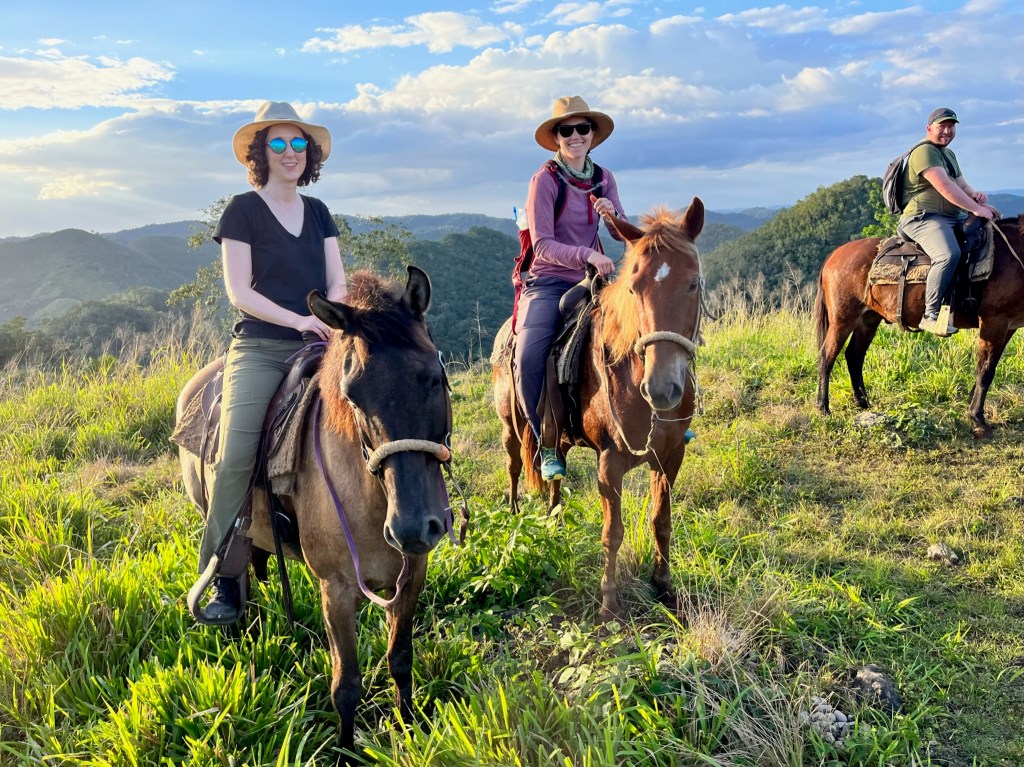
Zoe riding Charlie, Anicka riding Bandido, and Skip riding Fernando the mule
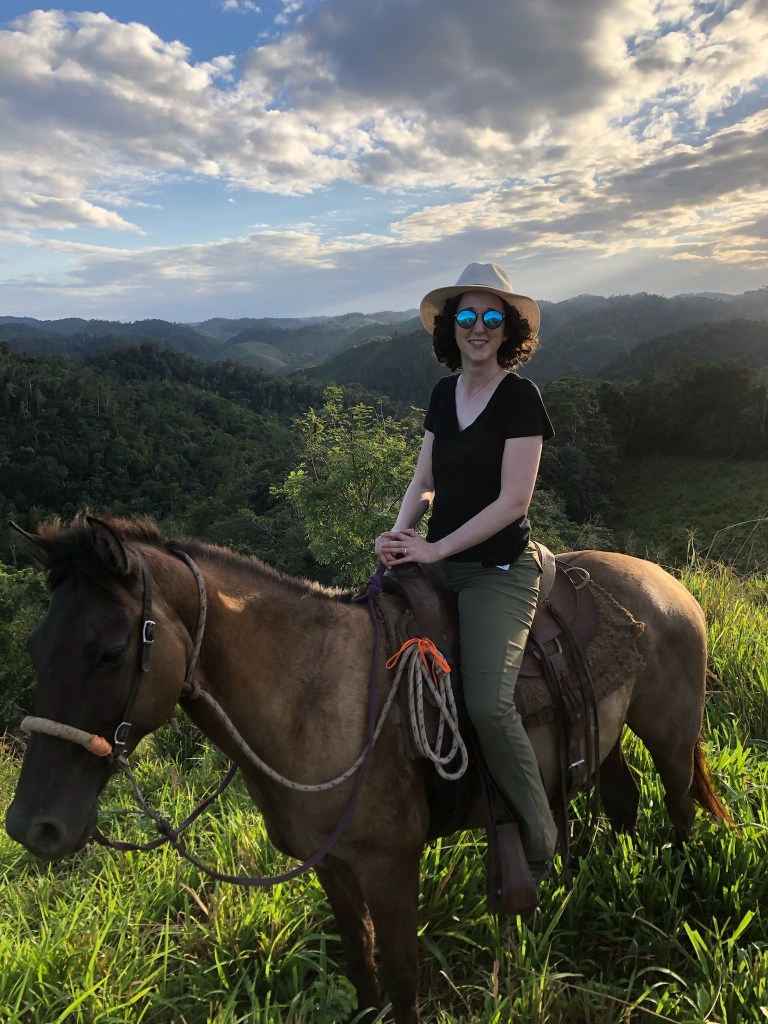
Jose took us up onto hillsides and down into valleys, pointing out plants and evidence of Maya homes. The horses were sure footed and expressed their personalities to our delight and terror (me). At one point Jose’s horse became upset that another horse had taken the lead, and he charged down the narrow path, knocking into the rest of us along the way. Later on the ride, another visitor’s horse ran into the dense jungle and she lost the reins as she tried to protect her face from thorny vines. Jose whipped around and raced toward her, pulling his machete out of his saddlebag as he went to clear away the undergrowth. For someone who has barely been on a horse in my life, the last time when I was maybe 10, it was a lesson in staying calm and trusting another being to literally carry me through.
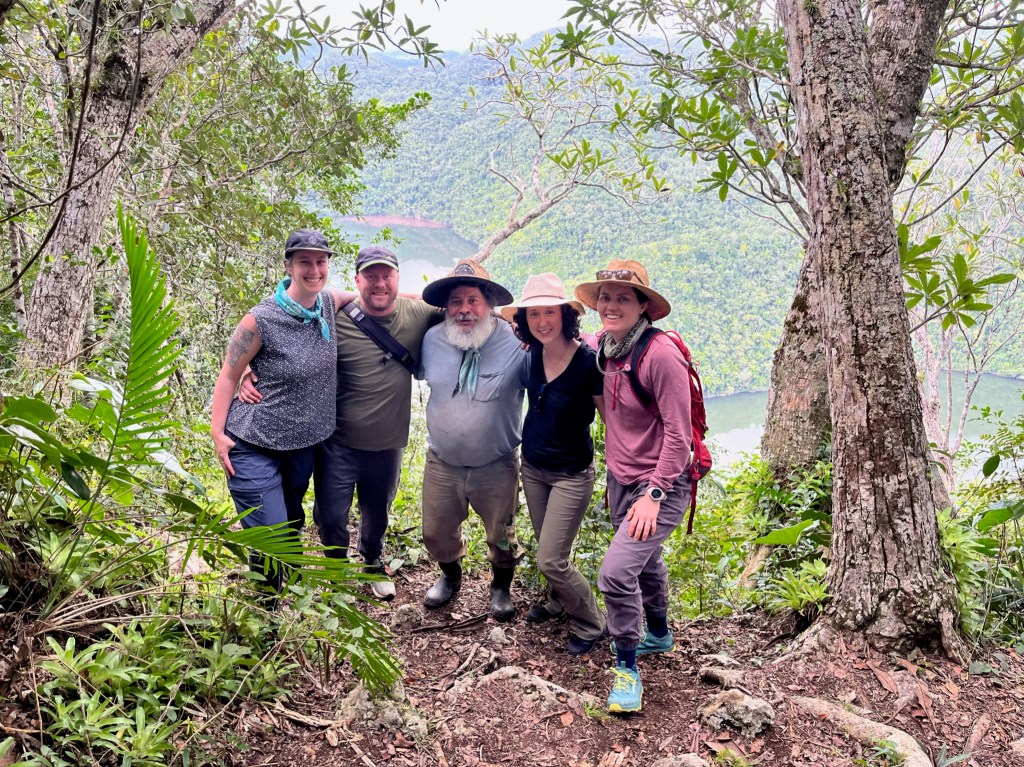
About halfway through our ride, we stopped at a mountaintop overlook of the river and surrounding areas. Jose recited his poetry to us about the safety of the jungle and musings on life.Anicka, Bandido, Shey, Canela (cinnamon), Skip, and FernandoBandido was the youngest and we often ended up near the back of the line, sometimes getting a kick to the face from Charlie for getting too close!
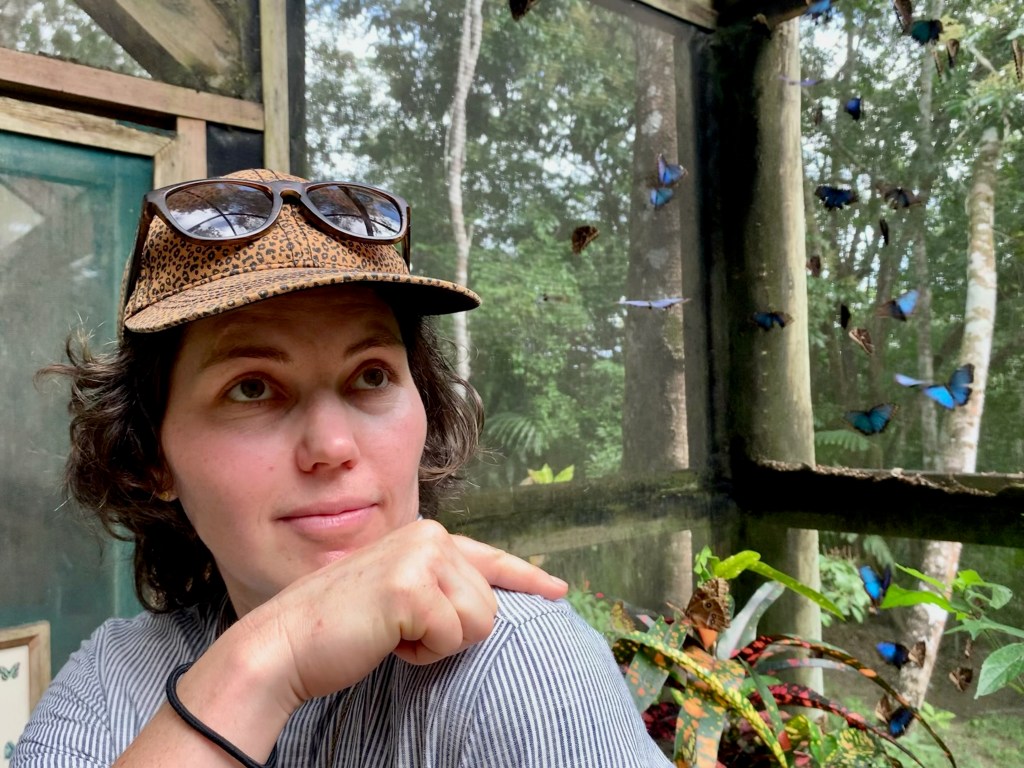
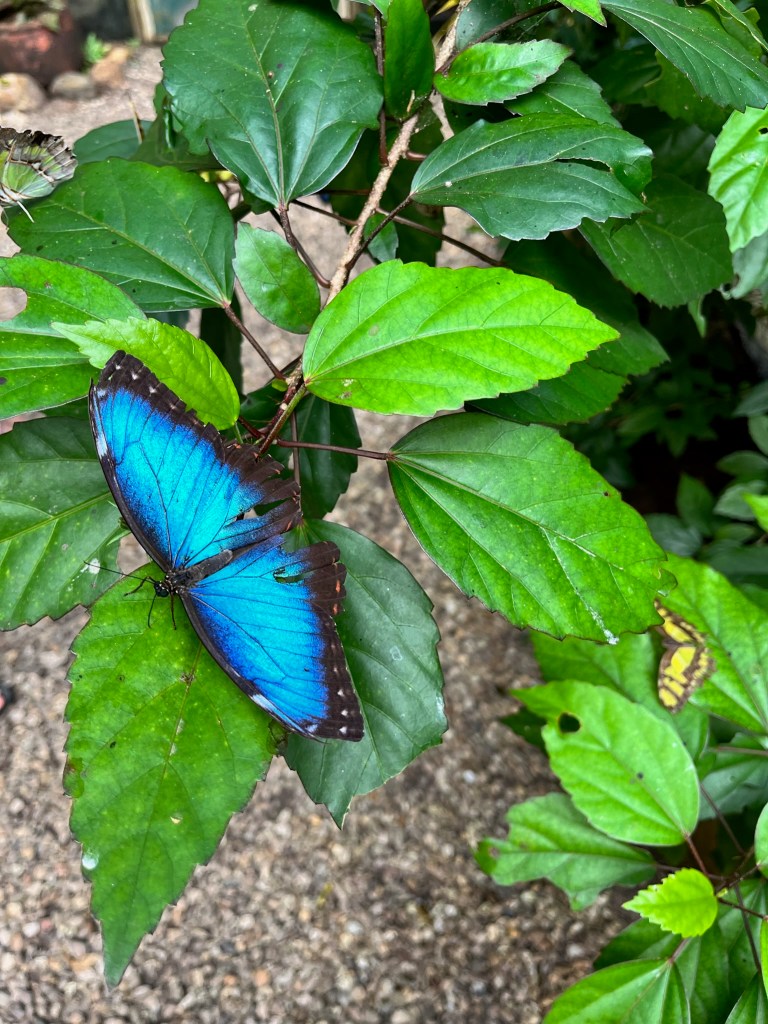
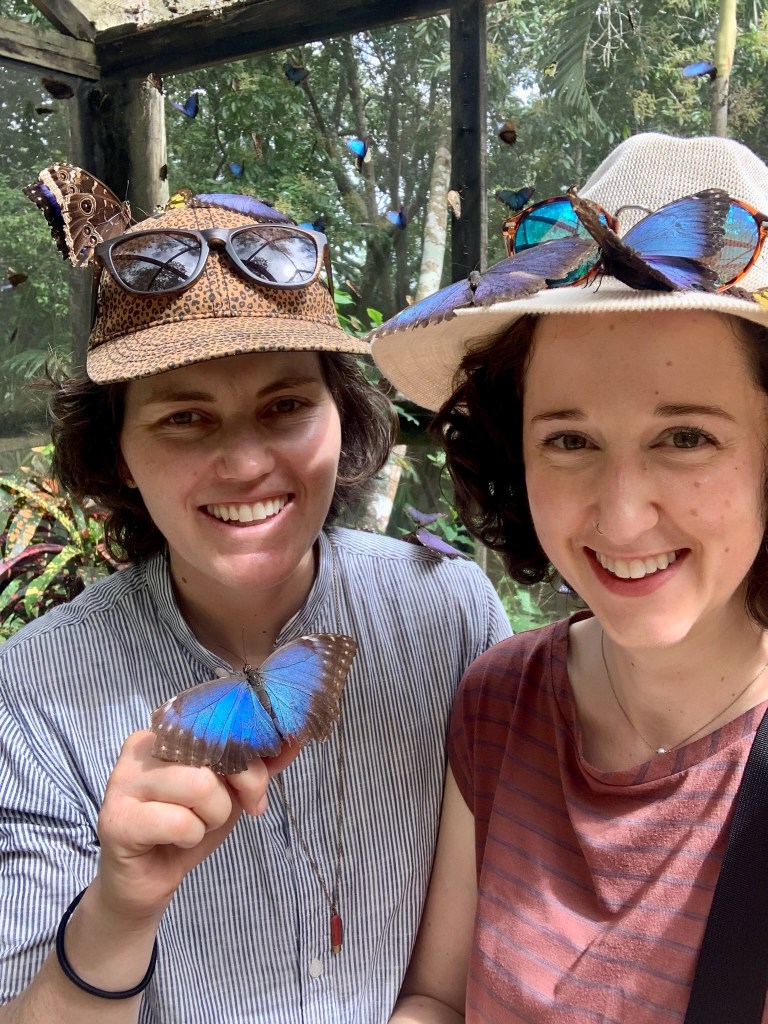
Our last full day in Belize we briefly explored Cahal Pech, the Maya ruins next door to our hotel. A landscaper told us stories of being involved in excavations over his 40 years working there, and pointed out structural features like the walkways that allowed space for headdresses and carvings on the seat of the king. We then made our way to a trail detailing native plants and their medicinal uses. We stopped by the Blue Morpho and Owl butterfly farm and spent many mesmerizing minutes in their presence. Finally, we took a dip in the Macal River. It all seemed too incredible to be real.
Their fruit food has to be replaced every two days otherwise the butterflies get too drunk!
We spent our last night in Belize City, ahead of our flight out the next day. We said a heartfelt goodbye to Zoe and Skip, who were the best traveling companions and truly made our entire trip possible. We missed them immediately. We spent an uneventful night in Guatemala City as there are no direct flights from Belize to Oaxaca, and arrived in the afternoon on February 2 after many delays. So starts the next chapter in our adventure!
 Anicka and Shey travel while gay